

How to design sustainable business events that deliver measurable impact
Sustainability is no longer a side initiative in business travel. As organizations increase in-person meetings and events, the challenge is clear: how do you balance experience, cost, and environmental impact without adding complexity? The answer lies in shifting from intention to structured, measurable action.
Sustainable business events require a coordinated strategy across planning, suppliers, traveler behavior, and data. Organizations that approach this holistically are seeing stronger outcomes across cost control, compliance, and traveler satisfaction.
Why sustainable business events are now business-critical
Business events remain essential for collaboration, innovation, and growth. At the same time, sustainability expectations from stakeholders continue to rise.
Today’s travel programs are shaped by multiple pressures:
- Increasing demand for measurable environmental impact
- Greater scrutiny on supplier sustainability practices
- Rising expectations from travelers around responsible travel
- The need to balance cost efficiency with ESG commitments
This shift means sustainability can no longer sit outside the travel program. It must be embedded into how events are designed, delivered, and measured.
The challenge: balancing experience, cost, and sustainability
Creating sustainable business events is not just about reducing emissions. It is about making smarter decisions that align with broader business goals.
Common challenges include:
• Limited visibility into event-related emissions
• Inconsistent supplier sustainability standards
• Difficulty aligning stakeholders across procurement, HR, and sustainability teams
• Concerns that sustainability increases cost or complexity
Without a structured approach, these challenges can lead to fragmented efforts and limited impact.
A practical framework for sustainable event design
To deliver meaningful outcomes, organizations should focus on four core areas.
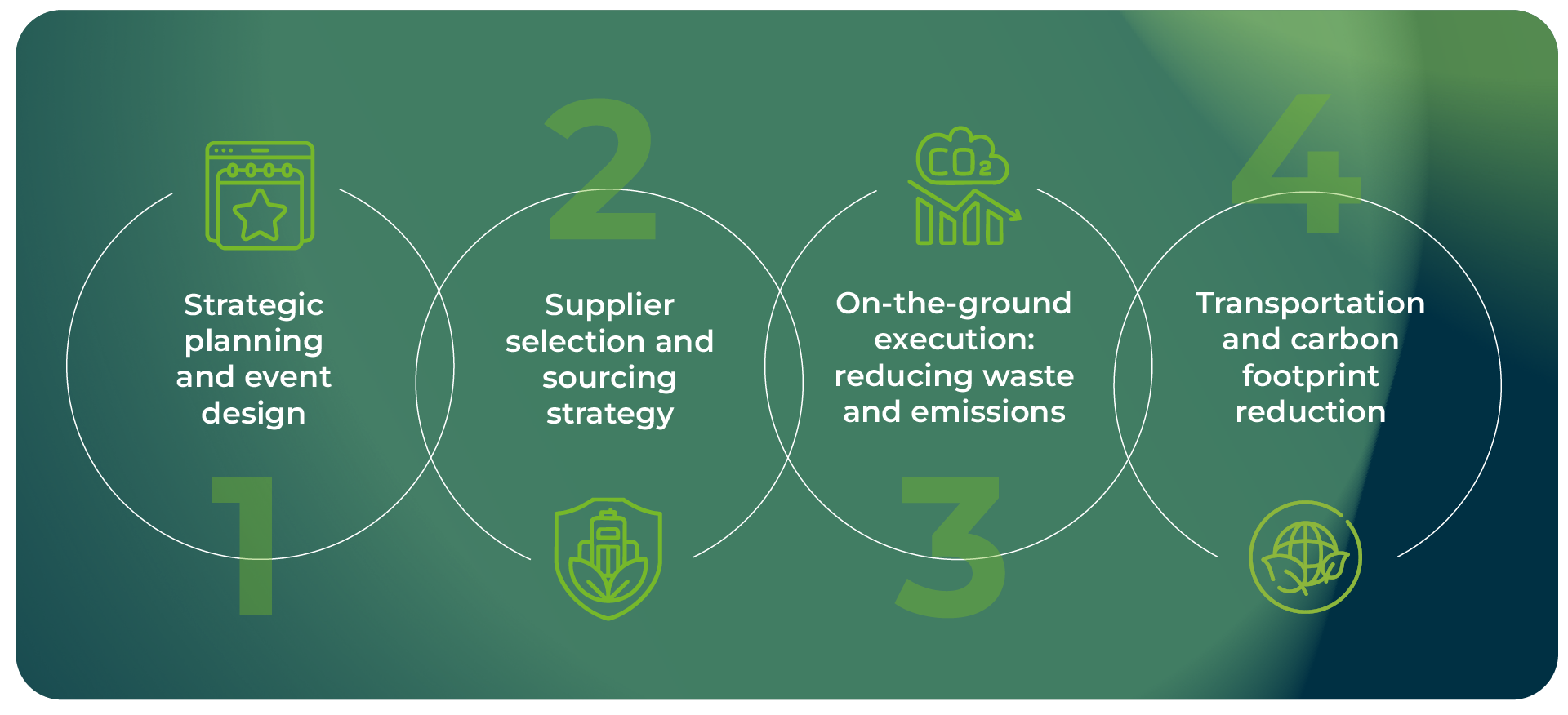
Strategic planning and event design
Sustainability starts in the early planning phase. Decisions made here have the greatest impact.
Key considerations include:
- selecting central locations to reduce travel distances
- designing agendas that optimize time and resource use
- incorporating hybrid or digital elements where appropriate
- aligning event objectives with sustainability goals
Clear alignment at this stage ensures sustainability is built into the event, not added later.
Supplier selection and sourcing strategy
Suppliers play a critical role in the overall environmental impact of an event.
Organizations should evaluate:
- venue energy efficiency and sustainability certifications
- waste management and recycling programs
- catering practices, including local sourcing and reduced packaging
- alignment with corporate sustainability policies
Shifting toward partners that share sustainability goals creates consistency across the event ecosystem.
On-the-ground execution: reducing waste and emissions
Execution is where strategy becomes tangible.
Practical actions include:
- minimizing single-use plastics and non-recyclable materials
- digitizing event materials and communications
- implementing clear recycling and waste management systems
- encouraging reusable items such as water bottles and event materials
Small, consistent actions at scale can significantly reduce environmental impact.
Transportation and carbon footprint reduction
Travel remains one of the largest contributors to event emissions.
Organizations can reduce impact by:
- selecting venues with strong public transport access
- encouraging shared transport options
- prioritizing hybrid or electric ground transport where available
- coordinating arrivals to reduce unnecessary journeys
These decisions not only reduce emissions but can also improve cost efficiency.
Where sustainable event strategies often fall short
Even well-intentioned strategies can fail without the right structure.
Common gaps include:
- lack of clear communication across stakeholders
- limited training or guidance for event planners
- inconsistent application of sustainability policies
- absence of measurable targets and reporting
Sustainability, like any travel program initiative, requires ongoing management, not one-time implementation. Without this, adoption and impact remain limited.
Turning sustainability into measurable outcomes with CTM
To move from intention to impact, organizations need visibility, control, and consistency. This is where the right travel management company (TMC) partnership becomes critical.
CTM Meetings & Events supports sustainable business events through a combination of technology and expertise:
• Data Hub provides consolidated emissions reporting, enabling organizations to track and measure event impact.
• CTM Portal ensures policy alignment and program visibility across stakeholders.
• Risk Hub enhances responsible travel by integrating duty of care with sustainability considerations.
By connecting data, suppliers, and traveler behavior, CTM helps organizations embed sustainability into every stage of the event lifecycle.
The future of sustainable business events
Sustainable event design is evolving from a compliance requirement to a strategic advantage.
Organizations that lead in this space are:
• integrating sustainability into sourcing and procurement decisions
• using data to guide continuous improvement
• aligning traveler experience with responsible travel practices
• partnering with TMCs that provide both technology and expertise
The result is not just reduced environmental impact, but stronger program performance overall.
Build sustainable business events that deliver measurable value.
Connect with CTM to explore how your travel program can drive impact with confidence.
What are sustainable business events?
Sustainable business events are designed to minimize environmental impact while supporting social and economic outcomes. This includes reducing emissions, minimizing waste, and selecting responsible suppliers.
How can companies reduce the carbon footprint of events?
Organizations can reduce emissions by selecting central locations, encouraging shared transport, using sustainable suppliers, and tracking emissions through reporting tools.
Do sustainable events increase costs?
Not necessarily. Many sustainable practices, such as reducing waste or optimizing travel, can lower costs while improving efficiency and compliance.
Why is sustainability important in business travel programs?
Sustainability supports ESG goals, improves stakeholder trust, and aligns with traveler expectations. It also helps organizations manage risk and future-proof their travel programs.
How can a TMC support sustainable events?
A TMC provides the tools, data, and expertise to embed sustainability into planning, sourcing, and reporting. This ensures consistent, measurable outcomes across the travel program.