

Why meetings and events management should align with your corporate travel program
In many organizations, business travel and meetings and events management are handled separately, often by different teams with different budgets, suppliers, and reporting structures.
Historically this made sense. Corporate travel programs focused on individual trips such as sales visits or client meetings, while meetings teams managed conferences, internal gatherings, and large group events.
However, as corporate travel programs become more complex, many organizations are reconsidering this separation.
Aligning meetings and events management with the corporate travel program can improve visibility of travel activity, strengthen supplier negotiations, and support better governance across the entire travel ecosystem.
After all, most business travel ultimately exists to enable meetings. Managing the two programs in isolation can create unnecessary fragmentation in budgets, data, and decision-making.
Should meetings and events be managed within a corporate travel program?
Many organizations still manage meetings and events separately from their corporate travel programs.
However, there is growing recognition that aligning the two can deliver meaningful operational and strategic benefits.
When meetings and travel programs operate within a connected framework, organizations can:
- gain greater visibility into total travel spend, including group travel
- combine travel volumes to strengthen supplier negotiations
- improve duty of care visibility for all travelers
- apply consistent policies and sustainability practices
Travel and meetings teams may still have different operational responsibilities. But aligning them under a broader travel strategy allows organizations to manage travel more effectively while improving oversight and reporting.
Why companies are aligning travel and meetings programs
Several operational and strategic pressures are prompting organizations to rethink how travel and meetings management should work together. As travel programs become more complex, organizations may look for ways to improve visibility, strengthen governance, and simplify how travel-related activity is managed across the business.
1. Rising travel costs and budget pressure
Corporate travel costs continue to fluctuate across airfares, accommodation, and ground transportation.
At the same time, organizations are increasing investment in meetings, events, and collaboration. Internal meetings, conferences, training sessions, and customer events all generate travel demand.
When meetings and transient travel are managed separately, organizations may miss opportunities to combine:
- hotel room night volumes
- airline agreements
- ground transport contracts
- event-related travel logistics
Bringing these activities together allows companies to present a more complete demand profile when negotiating with suppliers.
Over time, this combined purchasing power can support more competitive agreements.
2. Stronger duty of care and risk management
Duty of care is a central responsibility for organizations with traveling employees.
When travel bookings are spread across multiple systems or teams, it can become difficult to quickly identify where employees are traveling or respond effectively during disruptions.
Aligning travel and meetings programs helps create a more complete view of traveler movement, allowing organizations to:
- identify traveler locations more quickly
- communicate updates during disruptions
- share information with risk management providers
Centralized travel data becomes particularly valuable during periods of operational disruption or regional risk events.
3. Sustainability and ESG reporting
Environmental, social, and governance (ESG) considerations are increasingly shaping corporate travel policies.
Meetings and events can represent a significant portion of an organization’s travel footprint. When these activities are managed separately from the travel program, tracking emissions and sustainability performance becomes more difficult.
Integrating travel and meetings programs allows organizations to:
- measure travel emissions more accurately
- apply consistent sustainability guidelines
- encourage responsible travel choices across the program
This alignment supports broader corporate sustainability reporting and travel program governance.

Benefits of an integrated travel and meetings program
When business travel and meetings management operate within a coordinated framework, organizations often see improvements across several operational areas.
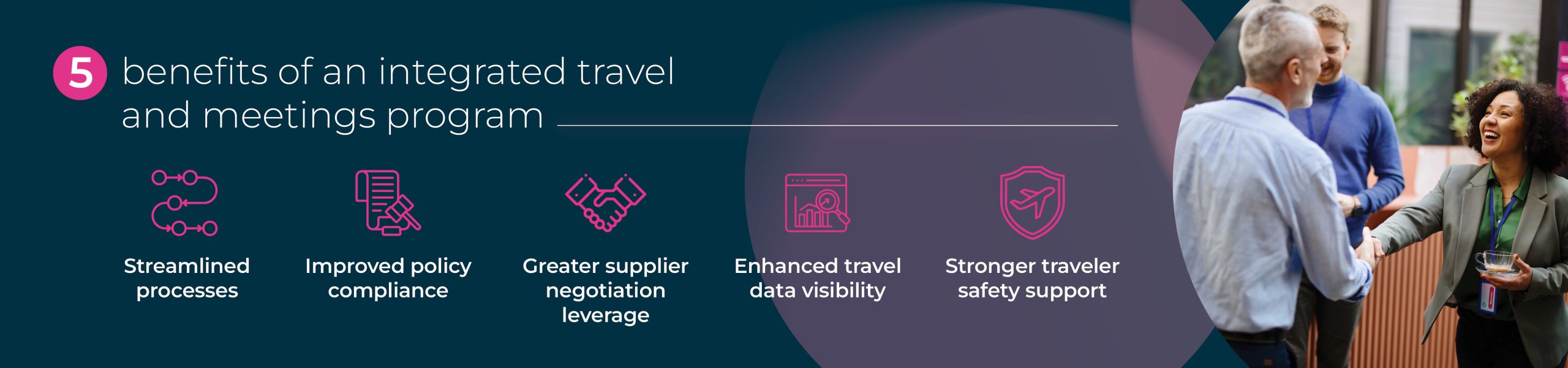
1. Streamlined processes
Managing both travel and meetings through a single travel management partner can simplify internal processes.
A centralized approach allows organizations to align:
- travel policies
- booking channels
- supplier relationships
- traveler support services
For example, organizations working with Corporate Travel Management (CTM) can manage both individual travel and group events through connected services and technology platforms.
This can reduce administrative complexity for travel managers, event planners, and travelers.
2. Improved policy compliance
An integrated program makes it easier to apply consistent governance across all travel activity.
When meetings and events bookings follow the same framework as individual travel, organizations gain better oversight of:
- preferred supplier usage
- travel approvals
- booking channels
- budget management
This helps reduce unmanaged travel activity and improves overall program compliance.
3. Greater supplier negotiation leverage
Supplier negotiations often rely on demonstrating travel volume.
When meetings and transient travel are managed separately, this volume can appear fragmented.
By combining the two programs, organizations can present a more comprehensive view of their travel demand to airlines, hotels, and other suppliers.
This can strengthen negotiating positions and support more strategic supplier partnerships.
4. Enhanced travel data visibility
Data visibility is one of the most valuable outcomes of aligning travel and meetings programs.
A unified program captures a complete picture of travel activity, including:
- individual business travel
- group travel associated with meetings and events
- associated travel spend
This consolidated data helps travel managers and procurement teams:
- monitor budgets more accurately
- forecast travel demand
- evaluate supplier performance
- report travel program outcomes to leadership
5. Stronger traveler safety support
An integrated travel program also strengthens duty of care capabilities.
When all travel activity is captured within a connected ecosystem, organizations can maintain a single source of truth for traveler movements.
Traveler tracking tools and risk alerts become more effective when all bookings, including meetings and events travel, are visible within the same framework.
Is it time to rethink how meetings and travel are managed?
As corporate travel programs evolve, many organizations are reassessing how meetings and events should sit within their broader travel strategy.
Aligning meetings and events management with the corporate travel program can help organizations move beyond fragmented processes toward a more coordinated approach that improves visibility, supplier leverage, traveler safety, and operational efficiency.
For companies seeking greater oversight of travel activity and spend, bringing travel and meetings management closer together may represent an important step toward building a more resilient and future-ready travel program.
Looking to align meetings, events, and corporate travel in your program?
Discover how an integrated approach can improve program performance across your organization.
Speak with a CTM travel expert
Should meetings and events be part of a corporate travel program?
Many organizations manage meetings and events separately, but aligning meetings and events management with the corporate travel program can improve spend visibility, duty of care oversight, and supplier negotiations.
What is meetings and events management in corporate travel?
Meetings and events management refers to the planning and coordination of group travel, conferences, internal meetings, and corporate events, including venue sourcing, attendee travel, and logistics.
Why integrate meetings and business travel management?
Integration helps organizations capture a complete view of travel spend, improve traveler safety oversight, and strengthen negotiating power with travel suppliers.
How does integration improve travel data visibility?
When meetings and individual travel bookings are managed through connected systems, companies can analyze total travel activity, track spending trends, and improve reporting across the travel program.