



Why mature travel programs need more than a booking tool
Technology maturity in corporate travel is often measured by which booking tool a program has, but the data says that’s the wrong measure.
Corporate travel technology maturity is not about which online booking tool a program uses. It’s about whether booking, servicing, visibility, and traveler support are connected into one experience, a distinction the CTM Travel Program Maturity Index shows most programs have not yet made.
Ask most travel buyers what “modern travel technology” means, and the conversation starts and ends with the online booking tool. A fast interface, a clean search experience, and accessible mobile booking. These are the features that get demoed, benchmarked, and put in front of stakeholders as proof a program has modernized. But an online booking tool is one moment in a much larger journey. And according to new research from the CTM Travel Program Maturity Index, that moment is not where technology maturity is won or lost.
Across 274 travel buyers surveyed, Technology & Ecosystem Integration scored just 43.6 out of 100, one of the lowest-performing dimensions in the entire study. Most of these programs already have an OBT, and even may have had one for years, but the score is low anyway. This suggests that the industry has been optimizing the most visible layer of travel technology while the layers underneath it, servicing, visibility, and traveler support, remain disconnected.
Check your program's maturity level
Adoption of a booking tool is not the same as technology maturity
It is easy to conflate a modern booking tool with program and technology maturity. It is the part of the technology stack travelers touch, so it becomes the part the whole program gets judged on.
But travel doesn’t happen in a single screen. A trip involves pre-trip approval, in-policy search, post-booking servicing, disruption support, expense reconciliation, and reporting back to the business. If those pieces don’t talk to each other, the traveler feels it immediately, even if the booking tool itself works perfectly.
This is why the Maturity Index treats technology as an ecosystem question, not a procurement question. The relevant test isn’t “do we have a modern OBT”, but rather “does our technology connect booking, servicing, visibility, and support into one coherent experience.”
The data behind the disconnect
The research points to a specific, addressable gap: integration.
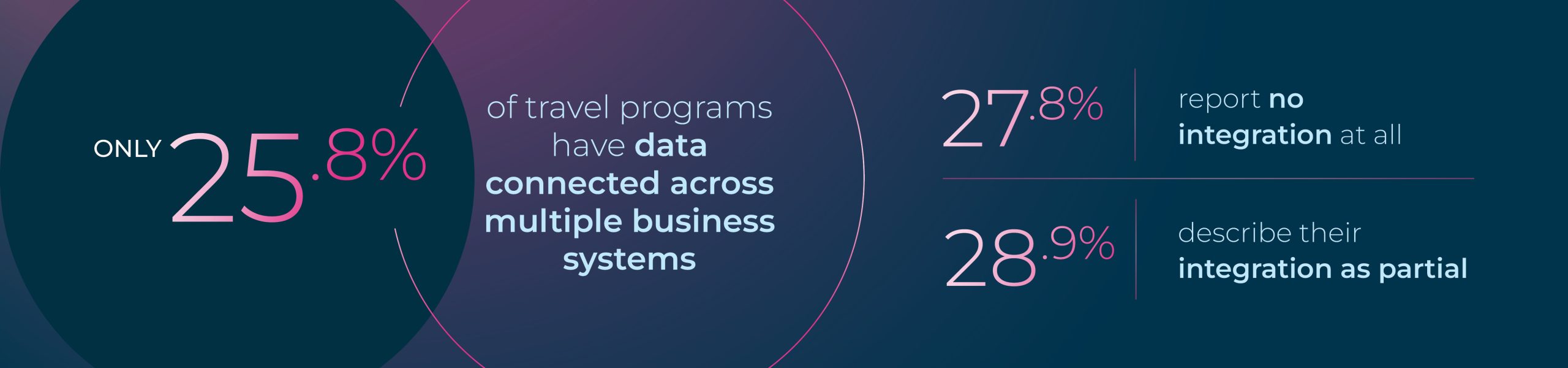
- Only 25.8% of travel programs have data connected across multiple business systems.
- 27.8% report no integration at all.
- 28.9% describe their integration as partial.
Meanwhile, technology limitations were cited as the single biggest barrier to advancing program maturity, ahead of budget, resourcing, and organizational silos.
Put simply, most programs are not held back by which OBT they chose. They’re held back by how little that OBT talks to everything else, mobile servicing, the traveler portal, expense and risk systems, and the data that should be turning bookings into decisions.
What’s driving program visibility isn’t a booking interface, it’s the infrastructure connecting data across the entire program.
What a connected ecosystem actually looks like
If technology maturity isn’t about the booking tool alone, what is it about? The Maturity Index points to four capabilities working together, not in isolation:
- Booking needs to be fast and policy-aware, but it’s the starting point, not the whole system. This is where tools like Lightning live: the entry point into the travel program.
- Mobile needs to carry the traveler through the parts of the trip that happen outside a desktop, itinerary changes, disruption alerts, on-the-go support. A booking tool that stops working the moment a traveler leaves their laptop isn’t a connected experience.
- Portal needs to give travel managers and arrangers visibility and control across the full trip lifecycle, from pre-trip approvals to post-trip reporting, not just the booking transaction.
- Data needs to connect what happens in booking, servicing, and support back into insight the business can act on. Without this layer, everything above it operates as a series of disconnected transactions rather than a program.
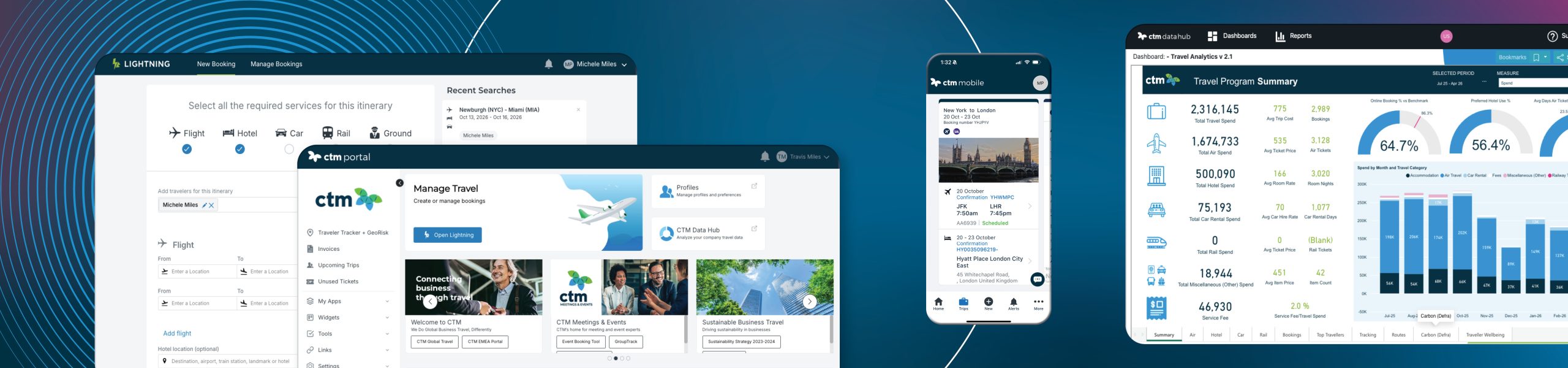
None of these four replace the others. A strong OBT with no connected data still leaves travel managers unable to answer basic questions about program performance. A strong data layer with a clunky booking experience still frustrates travelers daily. Maturity comes from the connections between them, not from any single one being best-in-class.
Why integration is the hardest part
Technology & Ecosystem Integration doesn’t score low because businesses lack access good products. It scores low because connecting technology across systems, data, processes and teams is far more difficult than adopting a standalone tool.
Rolling out a new OBT is a project with a start and end date. Connecting that OBT to mobile servicing, a traveler portal, and a data platform, and keeping those connections alive as suppliers, policies, and systems change, is ongoing work. It requires governance, IT partnership, and sustained attention that a single tool rollout doesn’t demand.
This is consistent with a broader pattern in the research: higher-maturity programs are distinguished less by the tools they’ve bought and more by the degree to which those tools are connected to the rest of the business. The same logic that applies to finance, HR, and risk data applies here. A booking tool sitting on its own, however modern, is still a silo.
The next step isn’t just a better booking tool
When a travel program feels behind, the industry’s instinct is to look at the OBT first. It’s the most visible piece, so it feels like the highest-leverage fix.
The Maturity Index suggests the opposite. Programs that are actually advancing are not the ones with the newest booking interface. They’re the ones that have connected booking to servicing, servicing to visibility, and visibility to data the business can use.
Technology maturity was never about having an OBT. It’s about whether booking, servicing, visibility, and traveler support work as one connected experience. That’s a bigger project than a software swap, but it’s also a more durable one. And it’s the difference between a travel program that has modern technology, and one that is actually technologically mature.
These findings are drawn from the CTM Travel Program Maturity Index, based on a global survey of 274 corporate travel buyers and program leaders, alongside in-depth interviews with travel management professionals across industries and regions.
Want to see how your program’s technology ecosystem measures up?
Read the full CTM Travel Program Maturity Index report and take the maturity assessment.
What does “travel technology maturity” mean?
Travel technology maturity is not about which booking tool a program uses. It’s about how well booking, servicing, visibility, and traveler support connect and work together across the entire trip lifecycle, according to the CTM Travel Program Maturity Index.
Is having an online booking tool enough to make a travel program mature?
No. In the CTM Travel Program Maturity Index, Technology & Ecosystem Integration scored just 43.6 out of 100 even though most surveyed programs already had an OBT in place. A booking tool alone does not create a mature, connected technology ecosystem.
Why do so many travel programs score low on technology integration?
Most programs are held back by disconnected systems, not a lack of technology. Only 25.8% of travel programs have data connected across multiple business systems, 27.8% report no integration at all, and technology limitations were cited as the single biggest barrier to advancing program maturity.
What does a connected corporate travel technology ecosystem include?
According to the Maturity Index, a connected ecosystem combines four capabilities: a booking tool (like Lightning) for fast, policy-aware search; mobile for on-the-go servicing and disruption support; a portal for visibility and control across the trip lifecycle; and data that turns booking and servicing activity into business insight.
How can travel programs improve their technology maturity?
Programs improve technology maturity by connecting their booking tool to mobile servicing, a traveler portal, and a data platform, rather than treating the OBT as a standalone system. This takes ongoing governance and IT partnership, not just a one-time software rollout.
What is the CTM Travel Program Maturity Index?
The CTM Travel Program Maturity Index is a global research study based on a survey of 274 corporate travel buyers and program leaders, combined with in-depth interviews, that benchmarks travel program maturity across eight dimensions, including technology and ecosystem integration.