

Why AI maturity is becoming the next challenge for corporate travel programs
AI adoption across corporate travel programs is accelerating rapidly, but not strategically.
From traveler servicing and chatbots to forecasting and expense auditing, AI is now embedded across many areas of the travel ecosystem. Suppliers are investing heavily, new capabilities are entering the market quickly, and travel programs are increasingly experimenting with AI-enabled workflows.
But adoption and maturity are not the same thing.
According to research by Business Travel News (BTN), only 1% of travel buyers say AI is currently being used strategically across their travel program.

That gap is becoming one of the most important challenges facing corporate travel leaders today. Many organizations are introducing AI faster than they are building the governance, integration strategies, and operating models needed to use it effectively
The result is an environment where many mangers of travel programs are still trying to determine:
- where AI is genuinely improving performance
- how to avoid fragmented traveler experiences
- how to manage growing concerns around data governance, and tool overload
- how much visibility do travel teams have into supplier AI usage
- where human expertise still matters most
AI adoption is growing, but maturity is still evolving
BTN’s global research showed AI adoption is already widespread across corporate travel programs:
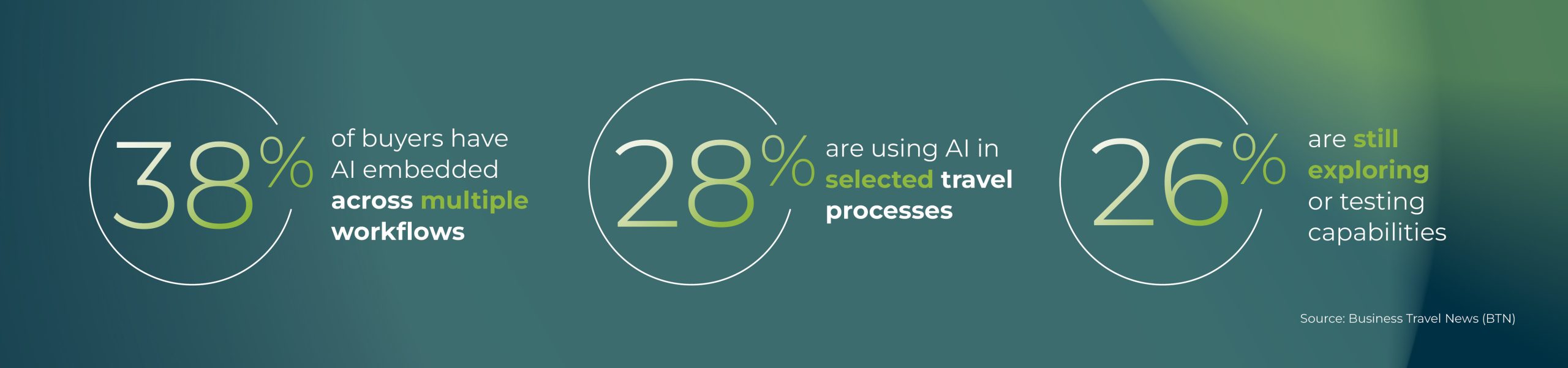
- 38% of buyers have AI embedded across multiple workflows
- 28% are using AI in selected travel processes
- 26% are still exploring or testing capabilities
Yet despite this momentum, strategic maturity remains low.
This suggests many organizations are adopting AI reactively through supplier platforms and new tools, rather than integrating it into a broader travel program strategy.
For travel managers, the challenge is no longer whether AI will become part of the travel experience. It already is.
The bigger question is whether organizations are implementing AI in a way that creates a more connected, intelligent, and supportive travel program, or simply adding another layer of complexity.
Without a clear strategy, there is a risk that AI becomes fragmented across multiple systems, creating inconsistent traveler experiences and limited operational value.
The industry may be focusing on the wrong AI use cases
One of the more revealing insights from the session was the disconnect between AI adoption and perceived effectiveness.
Traveler servicing and chatbots were identified as the most widely used AI applications across travel programs. Yet they also received the lowest effectiveness ratings from buyers.
Meanwhile, lower-profile use cases such as:
- forecasting and demand modelling
- expense auditing and fraud detection
- sourcing and RFP support
were viewed as delivering significantly stronger operational value.
This reflects an important shift in how organizations may need to think about AI investment.
Highly visible AI features often generate the most attention, but they do not always create the greatest business impact.
In many cases, the bigger opportunity sits behind the scenes, where AI can improve decision-making, identify patterns, reduce manual effort, and help travel managers operate more strategically.
For Corporate Travel Management (CTM), this reinforces the importance of viewing AI as an intelligence layer embedded throughout the travel ecosystem, rather than as a standalone feature or isolated tool.
Eric Ediger, Global Head of Automation & Machine Learning at CTM, says the challenge for many organizations is not access to AI capability, but how those capabilities are connected across the traveler experience.
“The industry does not need more disconnected AI tools. The real opportunity is creating intelligent experiences that surface the right information, at the right time, within the workflows travelers and travel managers are already using every day.
“When AI is embedded thoughtfully across the ecosystem, it reduces friction rather than adding to it. That is where organizations begin to see meaningful operational and traveler experience value.”
The future of AI in corporate travel will be shaped by seamless intelligent experiences, whether through online booking tools, mobile experiences, collaboration platforms, or traveler support environments.
The goal should not be to introduce more technology for the sake of it. It should be to reduce friction, simplify decisions, and improve support in moments that matter most.

Governance is becoming just as important as innovation
While AI adoption is increasing, governance frameworks are still catching up.
BTN’s research shows:
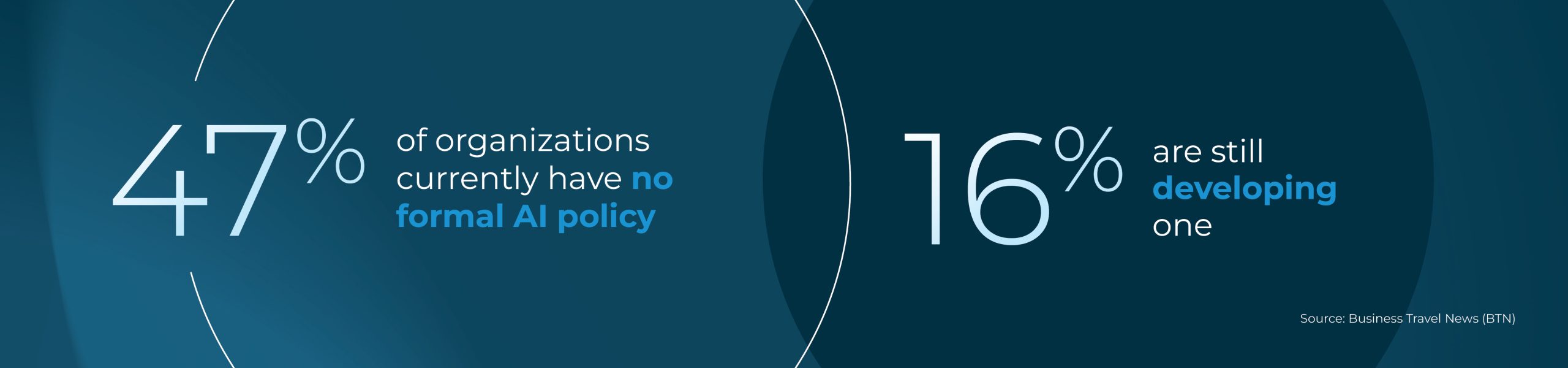
- 47% of organizations currently have no formal AI policy
- 16% are still developing one
At the same time, buyers identify several growing concerns:
- Data privacy and security
- Limited visibility into supplier AI usage
- Fragmented technology environments
- Increasing tool overload
This creates a difficult balancing act for travel programs.
AI capabilities are already becoming embedded into supplier platforms and operational workflows, but many organizations are still defining how those technologies should be governed internally.
As AI adoption matures, travel buyers are placing greater focus on questions such as:
- Where is traveler data being stored?
- How are AI-generated recommendations being surfaced?
- Are decisions transparent and explainable?
- How much visibility exists across supplier ecosystems?
This is becoming an increasingly important part of travel program management, particularly as organizations place greater emphasis on responsible technology adoption and traveler trust.
AI is changing how suppliers are evaluated
AI is also becoming a more significant factor in supplier selection decisions.
BTN’s research showed:
- 36% of buyers now view AI as a primary driver in supplier selection
- 23% consider it a major differentiator
This signals a broader shift across the industry.
Travel programs are no longer evaluating suppliers solely on pricing, inventory access, or servicing models. Increasingly, they are also assessing:
- how AI capabilities are integrated into the user experience
- whether suppliers can deliver more personalized support
- how intelligently workflows connect across platforms
- how transparently data and AI models are managed
This will likely become a much larger focus within future RFP and supplier evaluation processes.
From automation to augmentation
A consistent theme that has been noted in industry discussions is that AI should not be viewed as a replacement for human expertise.
Instead, the greatest opportunity may come from augmentation.
This means using AI to automate routine tasks, surface insights faster, and reduce operational friction, while still enabling human expertise to step in during higher-value or more complex moments.
Ediger says the most effective AI strategies will be those that enhance human expertise rather than attempt to replace it entirely.
“AI is incredibly effective at reducing manual effort and surfacing insights quickly, but there are still moments in travel where context, judgement, and empathy matter enormously.
“The future is not human or AI. It is designing experiences where both work together seamlessly.”
That balance becomes particularly important during disruption, urgent itinerary changes, policy exceptions, or high-stakes traveler situations where context, judgement, and empathy remain critical.
As AI capabilities continue to evolve, the organizations likely to gain the greatest long-term value will not necessarily be those adopting the most tools.
They will be the ones integrating AI most thoughtfully across the traveler experience.

What travel programs should focus on now
As AI adoption accelerates, travel programs should focus on three critical areas:
- Prioritize connected workflows over isolated tools: AI should improve how the entire travel ecosystem works together, not create disconnected experiences across multiple platforms.
- Build governance alongside adoption: Policies around data management, transparency, privacy, and supplier accountability need to evolve in parallel with AI usage.
- Focus on outcomes, not hype: The most valuable AI use cases may not always be the most visible. Organizations should focus on where AI can drive operational improvements, traveler confidence, and better decision-making.
AI in corporate travel is entering its next phase
AI is no longer a future discussion for corporate travel programs.
It is already influencing how travel is booked, managed, supported, and evaluated across the industry.
But while adoption is accelerating, maturity is still evolving.
The next phase for corporate travel will not simply be about implementing more AI.
It will be about integrating it more intelligently, more transparently, and more strategically across the travel experience.
AI adoption is no longer the differentiator. Strategic integration is.
Discover how CTM is helping organizations embed AI more intelligently across the travel experience.
Speak to our team.
How is AI currently being used in corporate travel?
AI is being used across traveler servicing, reporting, forecasting, expense auditing, sourcing, and operational workflows. Most travel programs are still in early or developing stages of maturity.
Why are many travel programs struggling to realize AI value?
Many organizations are adopting AI through individual tools or supplier platforms without a broader integration or governance strategy, creating fragmented experiences and unclear ROI.
What are the biggest concerns around AI in corporate travel?
Key concerns include data privacy, governance, transparency, supplier visibility, and managing multiple disconnected tools across the travel ecosystem.
How is AI changing supplier selection?
Travel buyers are increasingly evaluating suppliers based on AI capabilities, personalization, workflow integration, and data transparency alongside traditional servicing and pricing considerations.
What does the future of AI in corporate travel look like?
The industry is shifting toward more connected and embedded AI experiences that augment human expertise, improve decision-making, and simplify the traveler experience.