

Why Business Travel Is a Unique Procurement Category
In most procurement categories, success is largely defined by the strength of the contract. In business travel, the contract is only the beginning.
Airfares change constantly, hotel rates fluctuate by location and season, and traveler behavior directly influences whether procurement strategies succeed or fail. At the same time, travel programs must balance cost control with supplier performance, risk management, traveler needs, and broader business objectives.
For procurement leaders, this creates a category that behaves very differently from traditional indirect procurement areas.
Dynamic pricing makes travel procurement fundamentally different
One of the defining characteristics of travel procurement is dynamic pricing.
Unlike many procurement categories where contracts establish fixed or predictable pricing, travel costs fluctuate continuously based on supply and demand. Airfares can change daily depending on route demand, airline capacity, and booking patterns. Hotel pricing varies by season, city events, and occupancy levels.
This means that strategies cannot rely solely on fixed price negotiations. Instead, procurement teams must focus on broader program structures, including:
- market share agreements
- volume-based contracts
- preferred supplier programs
- rate caps
- benefits and inclusions
- data analysis of booking behavior and travel patterns
Success in travel procurement often depends on understanding how travelers book, not just how contracts are negotiated.

Travel procurement involves multiple supplier categories
Another factor that differentiates travel procurement is the number of supplier categories involved.
A typical corporate travel program includes:
- airlines
- hotels
- ground transportation services
- Travel management companies
Each of these supplier categories operates differently and requires separate negotiation strategies, performance monitoring, and policy considerations.
Airline negotiations, for example, may focus on route coverage, market share commitments, fare structures, and sustainability initiatives. Hotel programs are often built around room-night volumes, geographic coverage, seasonal pricing, and traveler safety considerations.
Ground transportation agreements may prioritize rate consistency, availability, and specialized vehicle requirements in certain industries.
Managing these categories effectively requires coordination across multiple suppliers while ensuring that contracts collectively support the organization’s travel policy and operational needs.
Traveler experience directly affects procurement outcomes
In many procurement categories, the end user has limited influence over purchasing decisions. Travel procurement is different because traveler behavior plays a significant role in program success.
If preferred suppliers do not meet traveler expectations for convenience, service quality, or availability, employees may book outside the approved channels. This reduces visibility into travel spend and weakens procurement’s negotiating leverage with suppliers.
Traveler experience therefore becomes an important procurement consideration. Programs that balance cost control with traveler convenience and comfort are more likely to achieve high compliance rates, which in turn strengthens supplier partnerships and improves contract outcomes.
For procurement teams, this means evaluating suppliers not only on price but also on factors such as reliability, traveler satisfaction, safety standards, and overall service performance.

Supplier performance is as important as negotiated pricing
Negotiating favorable rates is only one component of a successful travel procurement strategy. Supplier performance has an equally important role in determining whether a travel program delivers value.
For example, consistent flight delays, poor hotel service standards, or limited vehicle availability can significantly affect traveler productivity and satisfaction. Over time, these issues may lead travelers to bypass preferred suppliers, reducing compliance and undermining procurement objectives.
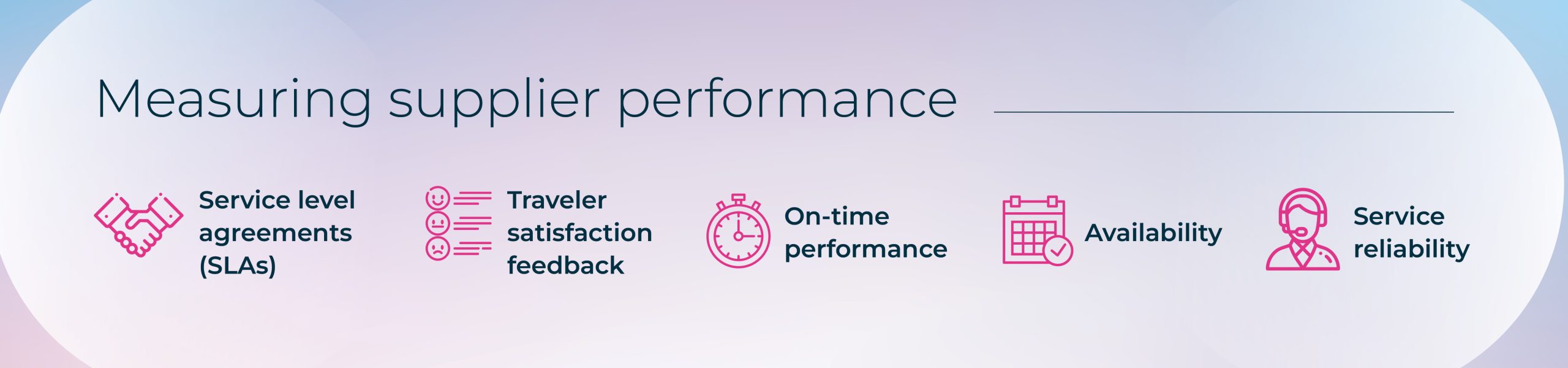
Effective procurement therefore requires ongoing monitoring of supplier performance through metrics such as:
- Service level agreements (SLAs)
- traveler satisfaction feedback
- on-time performance
- availability and service reliability
Using this data to review supplier relationships allows procurement teams to address performance issues early and strengthen future negotiations.
External factors can rapidly change travel conditions
Travel procurement strategies must also account for external factors that rarely affect other procurement categories.
Weather events, geopolitical developments, natural disasters, and operational disruptions can all influence travel availability and pricing. These factors may require rapid changes to itineraries, supplier arrangements, or travel policies.
Because of this volatility, travel programs rely heavily on real-time data, communication tools, and supplier coordination to respond quickly when conditions change.
For procurement teams, this reinforces the importance of strong partnerships with travel suppliers and service providers who can support the organization during disruptions.
Technology and data are critical for managing travel procurement
The complexity of travel procurement means that data visibility and technology platforms play a central role in program management.
Procurement teams increasingly rely on travel reporting tools and business intelligence platforms to monitor travel spend, booking patterns, supplier usage, and policy compliance. These insights support more informed negotiations with suppliers and help organizations identify opportunities to improve program performance.
Technology also enables real-time communication with travelers, automated policy enforcement, and consolidated reporting across multiple supplier categories.
As corporate travel programs continue to evolve, data-driven decision making is becoming an essential capability for procurement leaders managing travel spend.
Travel procurement is increasingly focused on value, not just cost
Traditionally, procurement success has often been measured through savings, negotiated discounts, and spend control. While these remain important, travel presents a unique challenge because it exists to enable business outcomes.
Unlike many procurement categories, business travel supports customer engagement, revenue generation, project delivery, employee development, and collaboration. As a result, organizations are increasingly looking beyond the cost of travel and focusing on the value it delivers.
This requires procurement teams to evaluate more than negotiated rates. Supplier performance, traveler adoption, program visibility, and the ability to support business objectives all influence whether a travel program ultimately succeeds.
Success is no longer measured solely by reducing travel spend. It is about ensuring travel investment delivers measurable value to the organization while balancing cost efficiency, supplier performance, traveler needs, and broader business priorities.
A unique procurement category requiring specialized expertise
Business travel is often categorized as an indirect spend category, but in practice it behaves differently from most other procurement areas.
Dynamic pricing, multiple supplier relationships, traveler behavior, and external disruptions all contribute to a procurement environment that requires specialized expertise and ongoing program management.
For procurement leaders, success depends on building a travel procurement strategy that balances cost efficiency, supplier performance, traveler needs, and organizational objectives while delivering measurable business value.
When managed effectively, business travel can deliver significant value to organizations by supporting productivity, strengthening relationships, and enabling growth across global markets.
Looking to streamline your travel procurement process?
Enhance your strategy with the expertise of our team!