
Why structured change management is a critical part of travel management strategy
Corporate travel programs are operating in increasingly complex environments. Technology platforms continue to evolve, distribution models are shifting, regulatory expectations are expanding, and traveler needs are becoming more diverse. At the same time, many organizations are managing travel across multiple regions, business units, and operating models.
In this environment, travel management strategy must do more than define policy and suppliers. It must also provide the structure that enables change to be introduced, coordinated, and sustained across the program.
Without structure, complexity amplifies risk. Even well-intentioned improvements can lead to inconsistent execution, fragmented traveler experiences, and reduced program visibility.
Structured change management helps ensure that travel management strategy remains aligned, scalable, and resilient as the travel environment continues to evolve.
Why complexity changes the role of travel management strategy
In simpler travel programs, change could often be managed informally. Policy adjustments, supplier changes, or technology upgrades could be implemented with limited disruption.
Modern travel programs rarely operate in that environment.
Global organizations now manage travel across multiple areas, regulatory requirements, supplier relationships, and technology ecosystems. Stakeholders span procurement, finance, HR, IT, risk, and executive leadership.
When change occurs in these environments, it rarely affects one function alone. A new booking platform affects travelers and arrangers. Supplier changes influence procurement strategy and cost visibility. Policy updates influence compliance, traveler experience, and duty-of-care oversight.
Travel management strategy must therefore account for both operational delivery and organizational alignment. Structured change management becomes the mechanism that ensures both move together.
The risk of unmanaged complexity
As travel programs grow in scale, the consequences of poorly managed change become more visible.
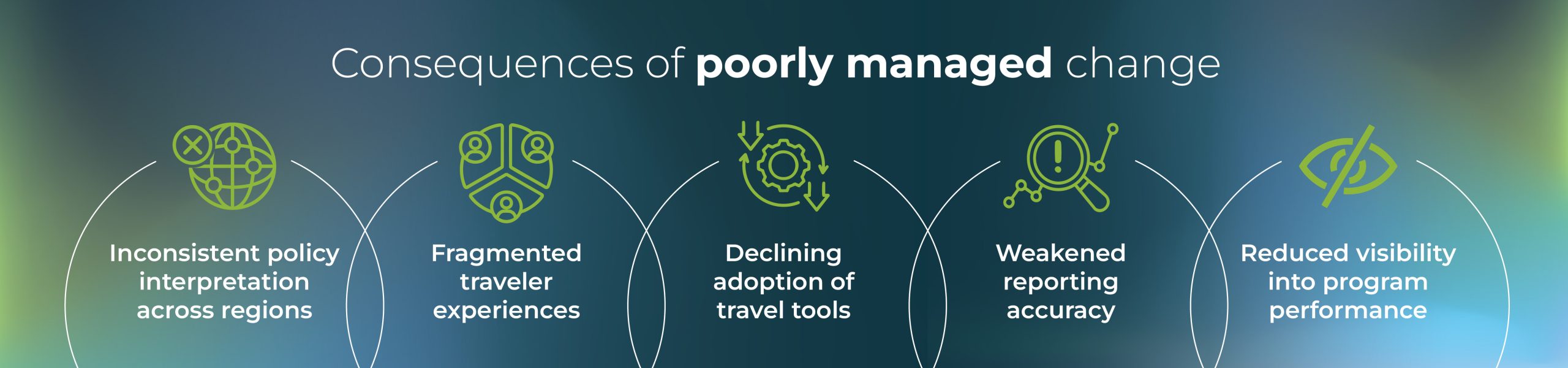
Without structured coordination, travel programs can experience:
- inconsistent policy interpretation across regions
- fragmented traveler experiences
- declining adoption of travel tools
- weakened reporting accuracy
- reduced visibility into program performance
These outcomes rarely appear immediately. More often they develop gradually as different regions, teams, or stakeholders respond to change in different ways.
Structured change management provides the discipline required to maintain alignment as complexity increases.
Structure supports consistency at scale
When change management is embedded within travel management strategy, organizations gain a consistent approach to introducing and sustaining improvements.
Clear governance ensures that decisions are visible and accountable. Communication plans ensure that stakeholders understand not only what is changing, but why. Training and enablement help operational teams apply new processes with confidence.
Equally important, structured reinforcement ensures that new behaviors are sustained over time rather than gradually reverting to previous habits.
In travel programs, this consistency is critical. It allows travel managers to introduce change while maintaining alignment across regions, business units, and operational teams.
This is where a structured, global approach becomes critical. At CTM, our one global model is designed to deliver consistency across regions while allowing for local nuance, supported by integrated technology, centralized data, and expert teams that guide change from strategy through to execution.
From reactive change to strategic travel management
As travel environments continue to evolve, organizations are being asked to adapt more frequently.
The most successful travel programs are no longer those that simply respond to change. They are the programs that have established the governance, communication, and operational structures needed to manage change consistently over time.
Travel management strategy must therefore move beyond responding to change. It must establish the structures that allow travel programs to evolve deliberately and confidently.
Structured change management provides that foundation. It allows travel leaders to guide stakeholders, maintain governance, and sustain adoption while programs continue to develop.
In complex travel environments, the ability to manage change effectively is no longer optional. It is a defining capability of successful travel management strategy.
 Download the eBook Managing Change in Modern Travel Programs to explore how structured change management supports long-term travel program performance.
Strengthen your travel management strategy.
Connect with our experts to explore how structured change management can support your travel program.
What is travel management strategy?
Travel management strategy defines how organizations manage corporate travel policy, suppliers, technology, governance, and performance across their travel program.
Why is change management important in travel programs?
Travel programs are influenced by evolving technology, supplier distribution models, regulatory expectations, and traveler needs. Structured change management helps organizations introduce improvements while maintaining adoption and alignment.
Why is structure important in travel management strategy?
Structure helps organizations introduce and sustain change consistently across regions, stakeholders, suppliers, and technology platforms. It provides the governance, communication, and accountability needed to maintain alignment and performance as travel programs evolve.
What role does governance play in travel program change?
Governance provides visibility, accountability, and consistency throughout the change process. It helps ensure decisions are implemented effectively, stakeholders remain aligned, and travel program performance is maintained over time.