
A practical framework for business travel program management
Learn MoreCorporate travel programs are under constant pressure to evolve.
New technology platforms, changing distribution models, stricter duty-of-care requirements, and increased financial scrutiny are reshaping the way organizations approach business travel program management. At the same time, travelers expect seamless, consistent experiences across regions.
The challenge is not deciding to evolve your travel program. It is ensuring that the organization moves with you.
That is why effective business travel program management must be anchored in a structured change management framework. A practical approach is built around the ADKAR model, ensuring change is not only implemented, but adopted, embedded and sustained.
Make change management stick
Why ADKAR matters in business travel program management
Travel programs are operationally complex. They sit at the intersection of procurement, finance, HR, IT and executive leadership. A new booking platform, supplier consolidation, policy adjustment or reporting structure does not affect one team; it affects the organization.
The ADKAR model provides a disciplined structure for guiding that change across five stages: Awareness, Desire, Knowledge, Ability and Reinforcement. When applied, it helps protect program performance while transformation takes place.
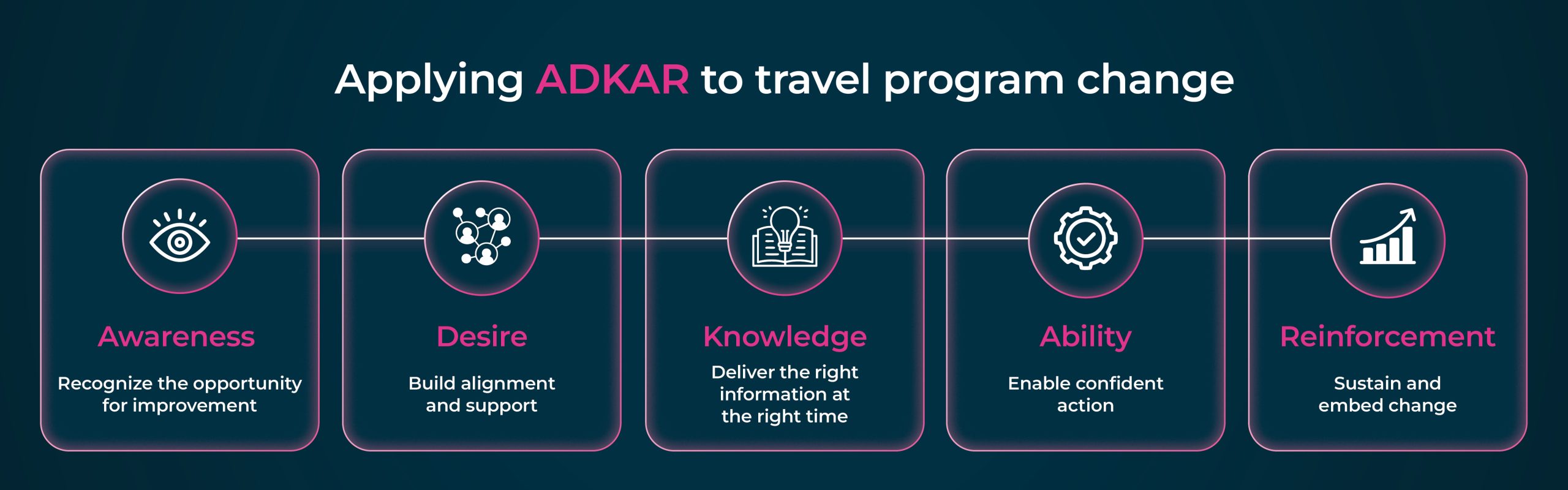
Awareness: Recognize the opportunity for improvement
Every successful change initiative begins with clarity.
In business travel program management, awareness means articulating why the current state is no longer sufficient. That may relate to declining travel program adoption or compliance, rising costs, stakeholder dissatisfaction and new business requirements.
Stakeholders need to understand not just what is changing, but what risk exists if nothing changes.
For global programs, this stage is particularly important. Without a clear narrative tied to company priorities, cost control, governance, risk mitigation or digital optimization, change can feel operational rather than strategic.
Awareness creates urgency grounded in business rationale.
Desire: Aligning stakeholders across the organization
Awareness does not guarantee commitment.
Procurement may focus on supplier efficiency. Finance may prioritise spend visibility. HR and Risk will look at traveller safety. IT will assess integration impact. Executive leadership expects continuity.
Effective travel program management requires deliberate stakeholder engagement at this stage. Leaders must connect the proposed change to each group’s priorities and clarify how the program will improve operationally, not just structurally.
Desire is built when stakeholders see tangible benefits and feel involved in the process.
Knowledge: Equipping the organization with the right information
Once commitment exists, practical enablement becomes critical.
Knowledge in business travel program management involves ensuring that operational stakeholders understand how change will affect daily workflows. That includes:
- booking processes
- approval structures
- reporting tools
- escalation pathways
- policy interpretation
This stage is frequently underestimated. Generic training or late-stage communication can create confusion that undermines adoption. A clear communication plan, supported by governance documentation and defined support channels, ensures consistency across regions and teams.
Ability: Enabling confident action
Knowledge does not automatically translate into action.
Ability is demonstrated when new systems are used confidently, policy compliance stabilizes and regional delivery remains aligned. This often requires monitoring, reinforcement and rapid intervention where friction emerges.
In global travel program management, the ability stage determines whether change embeds consistently or begins to diverge across regions.
Clear service expectations, hands-on training, access to support and expertise, performance tracking and operational oversight are essential to prevent fragmentation.
Reinforcement: Sustaining long-term performance
The final stage, and often the most neglected, is reinforcement.
Without structured follow-up, travel programs gradually revert to previous behaviors. Informal workarounds reappear. Governance weakens. Visibility declines.
Reinforcement in business travel program management should include:
- scheduled governance reviews
- transparent performance reporting
- executive-level accountability
- ongoing stakeholder engagement
This ensures that change strengthens the program over time rather than creating short-term disruption.
Applying the ADKAR framework in practice
When the ADKAR model is embedded within travel program management, change becomes strategic rather than reactive.
Instead of focusing solely on implementation timelines, travel managers can focus on adoption, alignment and measurable performance. Governance becomes visible. Accountability is defined. Regional execution is consistent.
In increasingly complex travel environments, this approach is no longer optional. It is foundational. Organizations that treat change as a governed process build travel programs that are resilient, scalable and aligned with business objectives.
Managing Change in Corporate Travel Programs, explores how to apply the ADKAR model in complex global environments. Download the eBook to explore the complete framework.

Build a structured approach to business travel program management
Connect with our experts to learn how
What is business travel program management?
Business travel program management is the structured oversight of policy, suppliers, governance and performance that ensures corporate travel operates efficiently and strategically across an organization.
How does the ADKAR model apply to business travel program management?
ADKAR provides a structured approach to managing change within travel programs by guiding organizations through awareness, stakeholder commitment, knowledge transfer, operational ability and long-term reinforcement.
Why do corporate travel change initiatives fail?
They often fail due to weak governance, poor stakeholder alignment, inconsistent regional execution and lack of reinforcement after implementation.
Why is reinforcement important in business travel program management?
Without reinforcement, travel programs risk reverting to previous behaviors, reducing compliance and weakening governance oversight.