

How to strengthen business travel safety across your organization
Learn howWhat is business travel safety and why does it matter today?
Business travel safety refers to the systems, policies, and processes organizations use to protect employees while they travel for work. As global risks increase and become less predictable, travel safety has become a strategic priority, requiring real-time visibility, structured response frameworks, and clear accountability across the organization.
The unpredictability of geopolitical tension, climate disruption, cyber threats, workforce fatigue, and regulatory scrutiny means business travel safety should no longer be reactive. It is a strategic responsibility of organizations.
According to the latest Risk Outlook from International SOS, 57% of risk leaders say new risks are emerging faster than they can manage, while 74% report that the time available to make critical decisions is shrinking. Yet only 35% feel confident they can mobilize teams quickly during disruption.
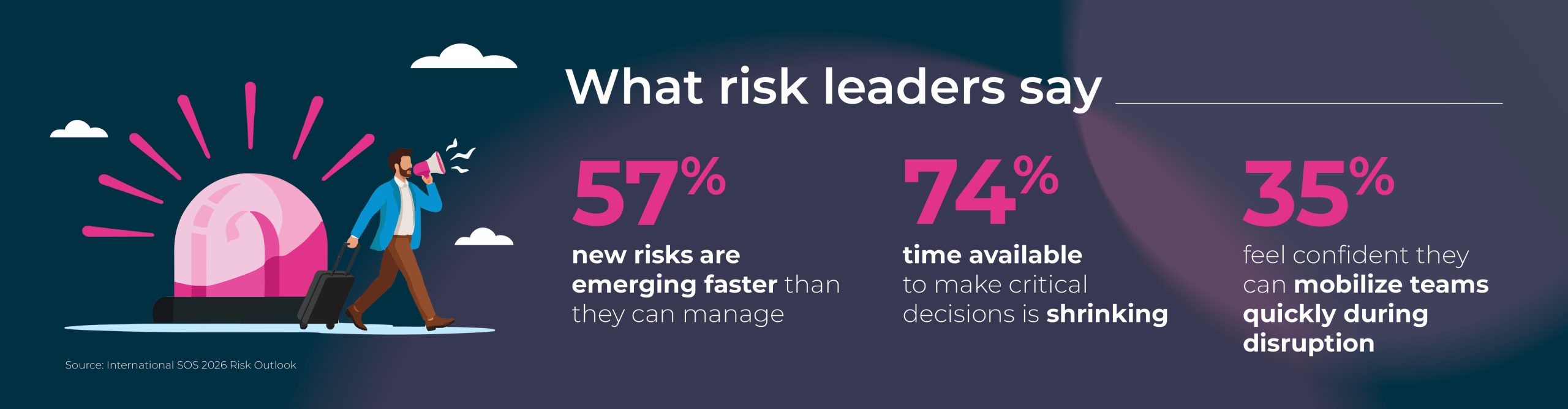
This gap between risk acceleration and response readiness highlights a critical reality: business travel safety cannot rely on policy documents alone. It requires governance, visibility, and structured accountability embedded across the organization. And those that embed this structure into their travel programs can create resilience before incidents happen.
Increasingly, organizations are addressing this gap by embedding risk management directly into their travel programs. At Corporate Travel Management (CTM), this means connecting policy, booking behaviour, and real-time visibility through integrated technology and expert support to enable faster, more coordinated responses.
Business travel safety is not a single policy document. It is an ecosystem of risk visibility, decision-making frameworks, traveler education, supplier alignment, and performance monitoring. At CTM, this ecosystem is brought together through a connected approach that integrates booking data, traveler tracking, risk intelligence, and communication into a single environment, giving organizations the visibility and control needed to respond with confidence.
Take control of travel risk with CTM’s Risk Hub
8 best practices that strengthen business travel safety across an organization.
These best practices are informed by CTM’s experience supporting organizations across a wide range of travel environments. Drawing on real-world program design, traveler behaviour insights, and risk management frameworks, they reflect how leading travel programs are evolving to strengthen safety, visibility, and response capability.
1. Establish clear governance and ownership
One of the most common weaknesses in business travel safety is unclear ownership.
Some organizations may have the responsibility of travellers split across job functions. When roles are fragmented, response times slow, and accountability weakens.
Strong travel programs clearly define:
- who owns the travel risk strategy
- who monitors emerging threats
- who approves high-risk travel
- who leads crisis response
- who communicates with travelers during disruption
Governance should be documented, communicated internally, and tested regularly. If escalation pathways are unclear during a minor disruption, they will fail during a major one.

2. Align travel policy with risk exposure
A travel policy focused only on cost control will not adequately support safety.
It must be reflected directly in policy through:
- approved booking channels for full visibility
- mandated use of managed suppliers
- pre-trip approval processes for higher-risk destinations
- clear expectations around itinerary sharing
- defined traveler responsibilities
Policy compliance is not about restriction. It is about ensuring the organization can locate, support, and assist travelers when needed.
When out-of-policy bookings increase, safety visibility decreases. Without full itinerary data, organizations cannot confidently execute duty of care.

3. Improve pre-trip risk assessment
Business travel safety begins before departure.
Pre-trip assessment should include:
- destination-specific risk intelligence
- health advisories
- environmental and climate risks
- infrastructure reliability
- cyber exposure
Travel risk management tools can help organizations identify and reduce risk exposure for business travelers more efficiently. Pre-trip reviews do not need to be complex. They simply need to be structured and appropriate for the level of risk.

4. Invest in traveler education and awareness
Even the strongest policy fails if business travelers do not understand their role.
Travel safety depends on informed travelers who:
- book through approved channels
- understand destination risks
- know how to access assistance
- recognize escalation procedures
- maintain cybersecurity hygiene
Education should not be a one-time onboarding exercise. Risk environments evolve quickly. Ongoing communication builds awareness and shared responsibility. Organizations that regularly brief travelers before high-risk trips may reduce incidents through simple preparedness.

5. Strengthen real-time visibility and communication
Visibility is the backbone of business travel safety. Without accurate, consolidated booking data, organizations cannot:
- locate travelers during emergencies
- send targeted alerts
- provide rapid support
- make informed operational decisions
Real-time communication tools, centralized itinerary data, and integrated risk alerts allow travel managers, HR and risk management teams to act quickly.
Speed matters. In high-risk scenarios, delays measured in minutes can compound impact.

6. Embed supplier collaboration into the safety strategy
Business travel safety is not managed in isolation. Airlines, hotels, ground transport providers, all contribute to traveler well-being. Strong travel programs incorporate supplier performance into safety conversations.
This may include:
- evaluating hotel security standards
- reviewing airline operational reliability
- assessing ground transport safety protocols
- monitoring supplier crisis response capabilities
Supplier selection should balance cost, service, and risk mitigation capability.

7. Conduct post-trip reviews and continuous improvement
Many organizations focus on prevention but may neglect evaluation. After disruptions, a structured review may help identify:
- where communication slowed
- where policy was unclear
- where traveler behavior created risk
- where supplier support was insufficient
Business travel safety should be measured and refined continuously. Regular program reviews, stakeholder workshops, and regular communication strengthen readiness.

8. Integrate well-being into safety strategy
Safety extends beyond physical threats. Traveler fatigue, stress, burnout, and mental health challenges can increase vulnerability and reduce performance. Organizations that design itineraries thoughtfully, allowing for appropriate rest and balanced schedules, help support healthier travelers and more productive trips.
Well-being is not simply a soft benefit; it is an important part of effective risk management.

A structured approach to business travel safety
Organizations that perform strongly in business travel safety typically share three characteristics:
- Clear governance and accountability
- Reliable data visibility
- Proactive, not reactive, risk management
When safety is embedded into policy, technology, supplier strategy, and traveler communication, resilience becomes part of the program design rather than an afterthought.
Business travel will always involve risk. The objective is not elimination. It is a structured mitigation supported by visibility, alignment, and leadership commitment.
If your organization is reviewing its business travel risk framework, now is the time to assess governance, policy alignment, and data visibility. A review can identify exposure gaps before disruption occurs.
CTM supports this structured approach by combining technology, data, and expert service to help organizations actively manage travel risk, rather than relying on static policies or reactive processes.
Strengthen your travel risk strategy with CTM’s Risk Hub
Book a demo
What is business travel safety?
It refers to the policies, systems, and processes organizations use to protect employees during work-related travel. It includes risk assessment, traveler visibility, emergency response planning, and supplier management.
Why is business travel safety important?
Organizations have a duty of care to employees. Beyond compliance, strong safety programs reduce disruption, protect business continuity, and safeguard brand reputation.
How can companies improve business travel safety?
Companies can improve safety by strengthening governance, aligning policy with risk exposure, improving data visibility, educating travelers, collaborating with suppliers, and conducting ongoing program reviews.
Does business travel safety only apply to high-risk destinations?
No. Risk exists across all destinations. While exposure levels vary, safety frameworks should apply consistently to all business travel to ensure visibility and preparedness.